Paranormal Investigation Society of Tennessee

Friday, July 8, 2016

Witch Way To Walk: A Stroll Through Salem


"More inhumanity (to man) has been done by man himself than any other of nature's causes."
-Samuel von Pufendorf, 1673


There are few towns or cities in the United States that conjure up lurid history like Salem, Massachusettes. Oh sure, most cities have their ghost stories and their haunted happenings, but none have capitalized on it quite like Salem.  It has built its entire economy on a series of events that happened over a span of 13 months in 1692-93: The Salem Witch Trials.

To understand the witch trials, you have to understand the mindset of the Puritans who lived there in the late 1600's.  The Bible was literally the Word of God, and if the Word of God said,"Thou Shalt Not Suffer a Witch to Live," then, by God, you did not.

Roger Conant, Founder of Salem
Witchcraft was real to the Puritans and anyone who has been through high school and read the play The Crucible knows how quickly events can escalate once the accusing starts.  The city of Salem has taken full advantage of this (just try to go there during the month of October to find out how much they capitalize on this: their police cars even have witches on them).

By the end of the trials, nineteen people had been executed, more had languished in prison, lost their farms and property, and generally had their world flipped upside down simply because, well, humans can be terrible to each other for very little reason.

Although Salem has prospered from the throngs of tourists who go there to see the witch trial museums and reenactments, it is a town with more stories than what history has inseparably linked it to.  It oozes history, right down to the original cobblestones that line its streets.  It was home to Nathaniel Hawthorne, whose great-great-grandfather was one of the judges of the witch trials (Fun Fact: Nathaniel Hawthorne changed the spelling of his last name so he wouldn't be associated with Judge John Hathorne.)

John Hathorne?  Never heard of him.
Travel to Salem and it's like stepping into a strange amalgamation of past and present. Houses from the 1600's sit across the street from modern houses and businesses.  Like most other cities, Salem has become famous for their tours, and the best way to see the town and hear the stories is to walk it.

As the three faithful readers of this blog are aware, I have written about ghost tours in other cities in previous posts (Wilmington and Savannah).  My wife and I are always big fans of ghost walking tours and try to go to them whenever we travel to a new city.  How would Salem, with all its documented history, compare to other cities?  It turns out, there's a lot more to Salem than its hysteria over witchcraft.

So, on a surprisingly chilly (for June) night, we met by the steps of the Old Town Hall in downtown Salem to walk about the town and get a feel for the heartbeat of Salem: the superb stories you only hear from the locals.

Old Town Hall in Salem.  Full disclosure: I stole this picture because I didn't think to take one when I was there.


Even though this will sound like a shameless plug, I cannot say enough positive things about our tour guide.  A walking tour lives and dies by how good its guide is, and our guide was one of the most engaging and best storytellers I've ever heard on a tour.  If you're ever in Salem, find the Witch City Walking Tours and speak with Beth.  Okay, shameless plug over...

The first stop on the tour was the site of the first church in Salem.
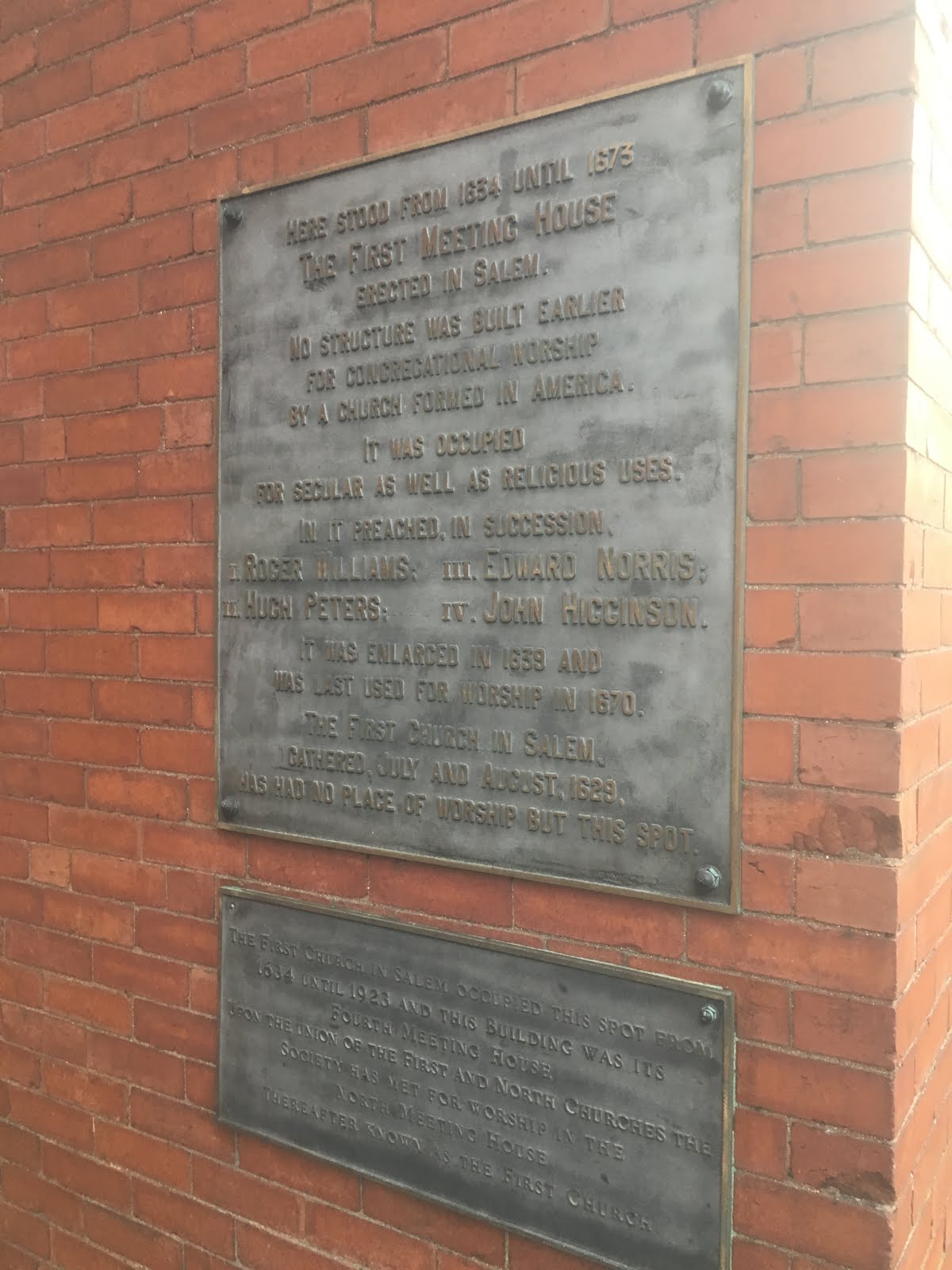
Historical marker denoting the site of the first meeting house of Salem

The above picture is hard to read from the angle it is taken from, but it says, "Here stood from 1634 until 1673: THE FIRST MEETING HOUSE erected in Salem.  No structure was built earlier for congregational worship by a church form in America.  It was occupied for secular as well as religious uses.  In it preached, in succession: Roger Williams, Hugh Peters, Edward Norris, John Higginson.  In was enlarged in 1639 and was last used for worship in 1670.  The first church in Salem gathered July and August 1629 has had no place of worship but this spot."

The lower marker reads: "The first church in Salem occupied this spot from 1634 until 1923 and this building was its fourth meeting house upon the union of the First and North Churches the society has met for worship in the North Meeting House thereafter as The First Church."

This spot is now home to a rather nice-looking restaurant called Rockafellas.

Rockafellas

Rockafellas is located in the historical Daniel Low building.  Daniel Low & Co were the first to capitalize on the Salem souvenir business when they started selling souvenir "witch spoons" in 1891. (Now, across the street, you can buy a t-shirt that reads "I Got Stoned in Salem.").  

Beneath the Daniel Low building is a series of old tunnels that were used for smuggling and helping hide slaves via the Underground Railroad.  The building is supposedly home to a mysterious lady in a blue dress who is said to haunt the place.  The story goes (if I remember it correctly) that a young lady was impregnated by a sailor and was expecting him to marry her.  Rather than marry her, the sailor murdered her and buried her in the tunnels beneath the building.  Now it is said that the restaurant is haunted by the "Blue Lady" screaming from the downstairs vault area (as if someone were down there buried alive).

True story?  Maybe.  It seems like a standard ghost story trope that's told in a lot of tours: a jilted lover wanting revenge.  In any case, it seems like a good way for a restaurant to sell drinks.  Apparently, Rockafellas has a specialty cocktail called "The Screaming Vault."

From there, it was a quick hop across the street to The Witch House (which sounds scarier than it is).
Witch house?  This house!

The Witch House was the home of Jonathan Corwin, one of the judges involved in the Salem Witch Trials.  It is significant because it is the only structure still standing with direct ties to the Salem Witch Trials.  Corwin signed several arrest warrants, but records don't show how much direct involvement he had in the execution of the nineteen who were convicted of witchcraft.  He had a son, George, who was the High Sheriff of Essex County.

George Corwin was not a good person.  One of his jobs was to sign arrest and execution warrants of those accused of witchcraft, which leads us to the story of Giles Corey.

"Giles Corey Pressed to Death Sept 9, 1692."


Giles Corey was an interesting fellow.  He was no saint (he beat one of his indentured servants to death after he was caught stealing apples) but he was no witch, either.  His case stands out in the witchcraft trials because he was the only one not hanged.  He was "pressed" to death.  George Corwin was the one in charge of torturing and eventually killing Giles Corey.

When he was accused of witchcraft, Giles refused to plead guilty or not guilty.  He did this so he would not forfeit his property.  A person who refused to plead could not be tried, so it was decided that he would undergo what the French called  Peine forte et dure (hard and forceful punishment).

Sheriff George Corwin led Giles out to a pit in an open field, stripped him naked, and laid him on the ground in the pit with boards across his chest.  Heavy stones were then placed on the board over his stomach and chest.  Giles still refused to plead or cry out.  Each time he was asked to plead, he would only respond with "more weight."  Sheriff George Corwin, being the great guy he was, would, from time to time, stand on top of the boulders pressing down on Giles.  When Giles's tongue would hang out of his mouth, George Corwin would take his cane and stuff it back in.

Giles endured for three days with more and more weight crushing his chest.  Just before he died, he cursed George Corwin and the town of Salem.  Since he refused to plead guilty or not guilty, his property passed on to his two sons-in-law instead of being forfeited to the state.  So Giles dies almost a martyr, and his gruesome execution starts to put a lot of doubt in the minds of the people of Salem about this whole witchcraft thing.

Howard Street Cemetery.  Giles Corey was pressed here and buried.


It's said that the ghost of Giles Corey appears in the Howard Street Cemetery just before disaster strikes the town.  His death takes us back to the story of Sheriff George Corwin.

Before Giles Corey died, he cursed George Corwin and ever since the curse (which was something like, "you'll die choking on blood") the position of Sheriff of Essex County has been said to have cursed as well down through history.  All the holders of that office since George Corwin have either died or resigned as a result of heart or blood ailments.  (The Sheriff's office was moved from Salem in 1991, which is said to have broken the curse.)

The Joshua Ward House: said to be the most haunted home in Salem


George Corwin was hated in Salem.  He was nicknamed "The Strangler" for his interrogation methods of those accused of witchcraft.  He also had his own jail in his basement.  George had a habit of making false accusations of witchcraft in order to obtain the accused's property.  Feelings ran high against him for this.  Oddly, he died at age 30 of some sort of blood ailment (The Curse of Giles Corey!).  However, he was so hated, that his surviving family didn't want to bury him in a cemetery for fear his body would be dug up and desecrated, so, they did what any caring family would do... they put him in the cellar.

So, George stayed in the cellar of the home for about two years.  In the mid-1780's, Joshua Ward built this house over the site of George Corwin's house/jail.  In fact, George Washington slept here.  So, this house is said to be haunted by the ghost of Giles Corey, and the ghost of old George Corwin himself (people have reported feeling choked), and the ghost of a woman who was thought to have been accused by Corwin.

There was a Christmas party being held there by a realty company, and the employees were having their pictures made to be put on a wreath.  One of the Polaroid pictures (this was the early 1980's, kids) showed this image when there was no one there...


The infamous "witch" photograph taken at the Joshua Ward House


Some think this was just a blurry photo of one of the employees, but there were other reports of strange happenings in the house:  candles blown out, things moved, lights on and off, doors opening and closing, etc.  People are convinced that George Corwin a.k.a. The Strangler did so many sadistic things in his basement/jail that the paranormal activity there is legitimate.

I have never seen the film Hocus Pocus, the 1993 film starring Bette Midler, but my daughter claims it is one of her favorite movies.  I take her word for it.

The Ropes Mansion

I am told this house, the Ropes Mansion, was a filming location for Hocus Pocus.  It's a beautifully restored mansion now run by the Peabody Essex Museum.  It's also supposed to be haunted.  It's caught fire three times.  Judge Nathaniel Ropes died of smallpox here, and his wife, Abigail Ropes was near the fireplace when her dress caught on fire, and she burned to death.  She is the one who is said to haunt the mansion.

The back corner of the Ropes Mansion seen from the garden.  Abigail died in that back corner room.


In the 1960's, the show "Bewitched" filmed an episode in Salem (look it up on YouTube, kids!) and when TV Land started airing the reruns, they placed a statue of Samantha in Salem.  It's pretty popular, and people are always stopping to have their picture made with it.

Samantha of "Bewitched."

The cosmic irony is that they placed the statue of land that was formerly owned by Judge John Hathorne (great-great-grandfather of Nathaniel).  I imagine he would not be pleased to see a statue of a witch on his property.

Speaking of John Hathorne:

The grave of John Hathorne "The Hanging Judge."


The last stop on the walking tour was this burial ground:

John Hathorne buried here

Those of you who remember your junior year of high school might remember John's great-great-grandson.  He wrote The Scarlet Letter and The House of Seven Gables and a bunch of short stories that might have put you to sleep when you were sixteen and thinking of other things.  He also wrote a book called Doctor Grimshawe's Secret.


Sofia Hawthorne's house.  It overlooks the Burying Point Cemetery


Nathaniel Hawthorne met his wife Sofia in this house, known as the Grimshawe House, and based his novel Doctor Grimshawe's Secret here.

So far as ever came to the present writers knowledge, there was no whisper of Doctor Grimshawes house being haunted; a fact on which both writer and reader may congratulate themselves, the ghostly chord having been played upon in these days until it has become wearisome and nauseous as the familiar tune of a barrel-organ.  The house itself, moreoever, except for the convenience of its position close to the seldom-disturbed cemetery, was hardly worthy to be haunted....
-Nathaniel Hawthorne
Doctor Grimeshawe's Secret


There were more stories, of course, during the tour, and to hear the rest, you'll have to take the tour yourself.  Salem may have fallen victim to its own tourism industry, but it's still worth going and finding out all you can about all the stories (witch-related or not).  It's a town that doesn't back away from his shady past (in fact, there would be no industry without it).

The Dead Don't Call Part 2

In a long-awaited follow-up to the previous post, it is sad to say after a review of our evidence we didn't catch anything.  I know this is disappointing to the five followers of this blog, but it is a topic we've addressed before: the hyped-up promise of paranormal activity that leads to...well, not much.  Nonetheless, it was a fun night out, we hope to catch something next time.

Monday, June 29, 2015

The Dead Don't Call Part 1

I look for ghosts, but none will force
Their way to me.  'Tis falsely said
That there was ever intercourse
Between the living and the dead."
                                                       -William Wordsworth
                                                           The Affliction of Margaret


William Wordsworth published his poem The Affliction of Margaret in 1807.  It was always seen as a "missing persons" poem, that is, the main character is a mother lamenting her lost son and wondering "what happened to him?"  Because the character of the mother has no closure about her missing child, she conjures up a lot of "what if?" scenarios which  range from "what if he's just snubbed me?" all the way to "what if he drowned when his ship sank?"  It is the precisely this uncertainty that gives the mother her grief.  Her son, we learn while reading the poem, has been missing for seven years.

Now, before someone points out the tragedy of a mother losing a child, we must be clear that the son is not a child.  He is an adult, and she at first worries that her nagging over him getting a job and earning some money might have driven him away, but she doesn't really worry about him as long as he just gets in touch with her.  This doesn't happen, and she is grief stricken that he is gone.  No cards on Mother's Day, no flowers, nothing.  The son just...is gone...

Here's the point.  We expect communication, and when it doesn't happen, we feel frustrated.  We think it is an easy thing, i.e., you tell me something, and in response, I reply.  You get the answer (whether it's the one you want is irrelevant) and the communication is complete.  When the communication cycle is one-sided, we feel...well...


So, this brings us to our latest investigation.  Wheeldon Manor in Central City, Kentucky.

Wheeldon Manor 

When one thinks of the word "Manor" a huge gothic house probably comes to mind.  This building, however, sits on a quiet street and could pass for any other large, relatively non-descript industrial structure.  You could drive by it every day on your commute and not notice it, even though it is rather large.  There is nothing on the outside to indicate it's anything special.

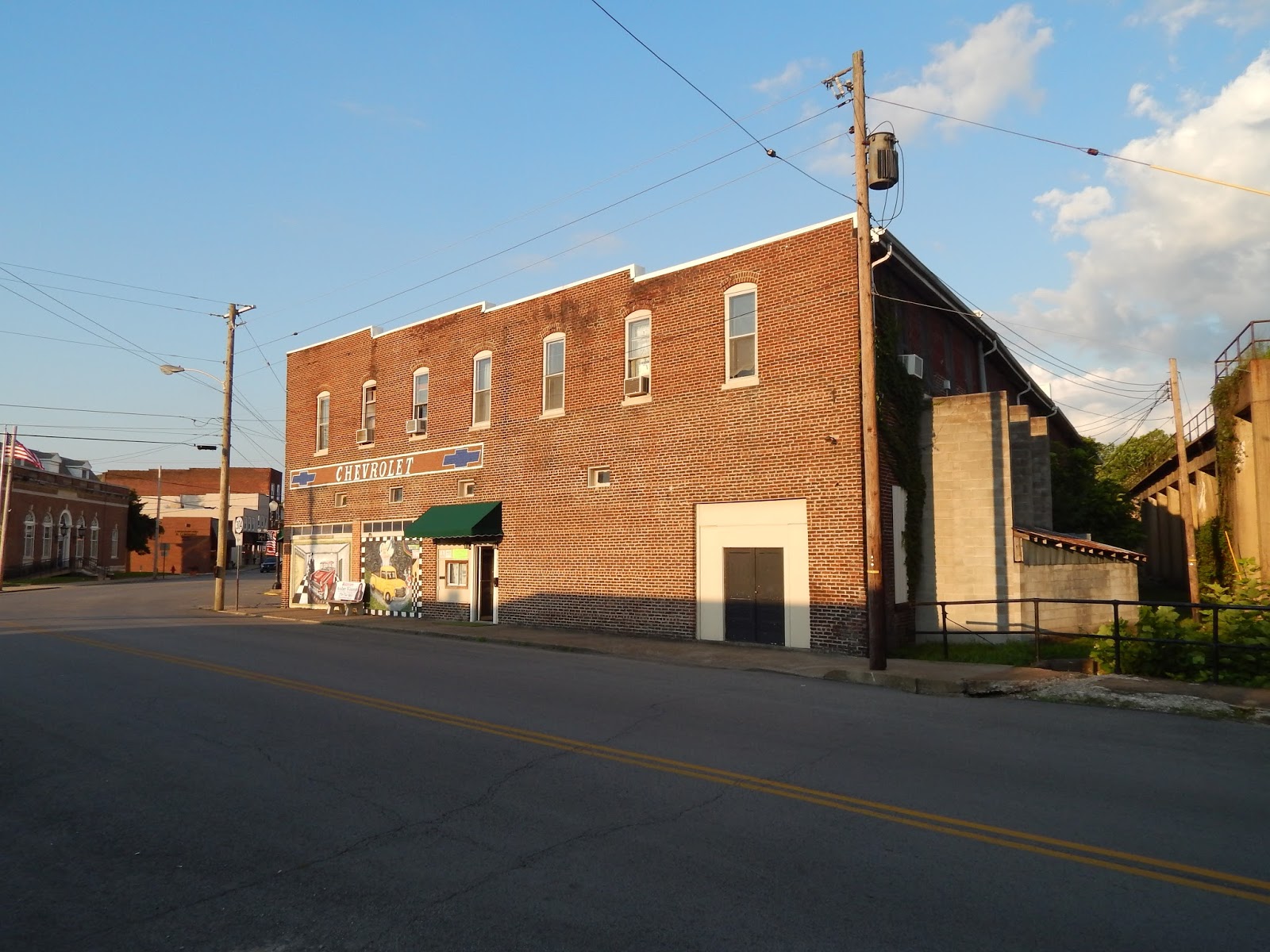
Wheeldon Manor storefront stretching down the street


It is, in fact, a 23,000 square foot building that dates back to the 1920's.  The upper floor (with the rounded windows) contains 11 apartments and the lower floor is a more open space, divided up for mixed purposes (like shops and such).  Through its history, this building has been used as housing for railroad workers, a saloon, a newspaper office, and even a brothel.  It has a long history, and the inhabitants who passed through all had their own histories and stories to bring with them.

A wider view of Wheeldon Manor.  The railroad tracks are to the right of this photo


Even though our group has been on other investigations since our last blog posting, those investigations were never written up in blog form (which is my fault...so...)  Nonetheless, when we go somewhere large like this, it's important to get it documented (as well as we can).

Wheeldon Manor is used as a haunted house attraction during the fall of the year, and there were a lot of props and such lying around the building (so if you see a creepy clown or a severed hand in any of the photos, don't panic.)  After a quick tour of the building, we decided some of us would stay in our makeshift "command room" while the others would go out into pairs into different parts of the building.  Most of these were for E.V.P. sessions because while the voice recorder is running, you don't want another group banging around with their footsteps and conversations which would interfere with your recording.

So, Wheeldon Manor is divided into three distinct sections: the apartments, the boiler room area (where the large store front area is located) and the "maze" in the basement (constructed for the haunted house attraction).

The maze is a series of dead ends and corridors the owners of the building had constructed out of plywood.  In the dark, it gets quickly disorienting down there.
The stairs leading down to the "maze"

So after exploring the maze and bumping into a few walls, we explored the apartments.  Most of the apartments are set up as "themed" rooms for when the building serves as a haunted house attraction.  Some of the rooms are staged like crime scenes, others are simply empty rooms.  The "staged" rooms are a little disconcerting until you get used to walking into a room and seeing, say, an evil clown standing in the corner.
Pay no attention to the clown in the corner...

The apartments are odd-sized (there are 11 in all).  It would be hard to imagine a person living in them, let alone a family, but nonetheless, they are all intertwined through a series of doors and passageways that are hard to navigate in the dark without some difficulty.
One of the apartment rooms.  It was quite dark, but the flash from
the camera lit everything up.

Some of the apartment rooms were said to have more activity than others.  Most of the activity from Wheeldon Manor was reportedly in the form of E.V.P.'s.  We placed our stationary cameras and voice recorders in the spots we thought were the most likely to have activity.

Then...we...waited...


Note: We'll post part 2 of this update after all the evidence is shifted through, so stay tuned! Don't worry.  I'm going to tie in the Wordsworth poem so everything will make sense in the end.

Wednesday, July 3, 2013

Strolling With Ghosts...

Go to practically any city of  significant size and often you will see brochures or advertisements promoting "Ghost tours" or "Ghost walks" or something to similar effect,  These companies decide that they will let you pay them ten or twelve bucks to walk you around the city to spooky-looking locations and then tell you a story about what happened there.  Some may think they are tourist traps, but there are also people who love them and seek them out whenever they can (this humble writer is one of those people...I love a good ghost story).

Now, nine times out of ten, one will not see a ghost on these tours, but the tour guides always prep their tours by telling the tourists they might see something.  The guides will usually reference things that happened on all those other tours (you know, the ones you never seem to be on when cool stuff happens...)

Just last week the humble writer of this blog and his wife were on vacation and traveled around the east coast for a bit.  We spent a big chunk of our time between North and South Carolina coastal areas, and that's how we found ourselves in Wilmington, North Carolina.

Ah, Wilmington.   Wilmington is the home of a tour I had never seen before but apparently is pretty famous.  Yes, the Wilmington Haunted Pub Crawl  (just an aside, if you ever find yourself in Wilmington, I would recommend this tour.  It's a lot of fun if you get the right tour guide, which I feel we did.  This guy was hilarious.)

The breakdown of the tour is this:  you start in one particular pub (and there are a lot of pubs in Wilmington, let me tell you) and have a drink and hear a ghost story.  After your drink you travel en masse to the next pub, where you repeat the actions of the first pub.  Wilmington has a lot of dark history, and the stories were very neat to hear.

It was a drizzling Wilmington night when we went out on our pub crawl.  We started at a place called Orton's, which holds the distinction for being the oldest continuously operating pool hall in America.  After a quick pint, we heard the story of Willie Stephens, a ladies man and all about rascal whose body was found in the wreckage of the building after it burned down in the late 1800's.

The Orton Hotel as it originally appeared before it burned down.


Now all that is left of the Orton is the original basement (where the pool hall is).  Willie haunts the pool hall and if he likes you, he will help your billiards game by moving the balls into the pockets for you, but if he doesn't like you, then you will play the worst game of pool, ever.  The world's record for consecutive pool shots was set in the Orton pool hall (they have a sign and everything attesting to this) and the man who made the records even confessed that some of his shots should never have gone in (but they did!)  The record is 365 shots in a row.

This sign hangs above the pool table where the record was set

We ambled out of Orton's and to the next pub...

The Black Sheep...built beneath an old Masonic Temple.

The Black Sheep tavern shares history with the Orton.  You see, they all used to be part of one huge connected building, but they were divided up into separate parts.  One thing that they have in common is the basement (which was later divided also) but the Black Sheep was built below a Masonic Temple (which seemed to have a shady history).  Another pint, another story, and we were off to...

The Liquid Room!

The Liquid Room...home of the world's crankiest elevator.

The Liquid Room has seen a lot of owners.  Each one sold the bar to the next owner after a bad experience.   The Liquid Room (on Market Street) was the location of the old slave market back in pre-Civil War days.  When the Nat Turner slave uprising happened, the citizens of Wilmington were afraid of a similar slave uprising in Wilmington, so they found six freedmen, charged them with false charges and had them all hanged on Gallows Hill (just up the street).  They put their heads on sticks and displayed them here in front of the slave market so the slaves up for auction would see the heads and take it as a lesson not to try anything themselves.  So, flash forward through the years and the Liquid Room becomes a hotbed of paranormal activity.  Claims of seeing people on stairs (who weren't there) shelves falling on their own accord, and....the elevator that has a mind of its own.

The elevator...to Hell!  Just kidding.   But these are the doors to the elevator that tries to kill people!

The elevator, despite being one of the old ones that you have to slide a little gate in front of to make the circuit connection to operate, moves on its own without having that gate shut.  Many elevator repairmen have checked it out and said it's impossible, but there it is.  One of the waitresses stepped into it and fell down into the shaft and narrowly missed impaling herself on the spikes at the bottom of the shaft.

Another pint, and off to The Blue Post....

Hungry?  Stop in for a bite!

The Blue Post is one of the older pubs in Wilmington and got its name because it used to be a brothel and a bar.  When the sailors got off their boats in the harbor and ask where they could get some refreshment and some "entertainment,"  Gallus Meg, the owner of the bar, had a post outside the front painted blue, so the sailors were told to "look for the blue post."

Speaking of Gallus Meg, she was a huge woman (about 6 foot 3) and 300 pounds of rock solid muscle.  If any of her customers mistreated or disrespected her ladies, she would take them out the back of the bar, put them in a stranglehold while beating the crap out of them, then she would bend down and bite the customer's ear off.  She then would walk back into the bar with the ear still between her teeth and spit it into a large pickling jar she kept on the counter.

(Just on a side note, if a sailor came into the bar and was hungry, Gallus Meg would offer that poor sailor a snack from the pickling jar.  It was pretty common to see a poor, starving sailor chewing away on a meaty treat from the pickling jar.  The other patrons got a big kick out of watching it.)

Anyway, Gallus Meg's luck ran out and she was found stabbed to death outside the back door of her pub.
Paradise Alley.  The back door where Gallus Meg's body was found

So the ghost of Gallus Meg apparently haunts The Blue Post and is only seen by men.  The story goes if a man accidentally wanders into the ladies' room, he will see a large woman behind him in the mirror who is looking like she is about to strangle him.

So to sum up thoughts about a haunted pub crawl.  It was a lot of fun.  Was it paranormal?  No.  But if you're interested in good ghost stories, it's worth checking out.

Although this wasn't an official Paranormal Investigation Society of Tennessee outing as a whole, sometimes it's good to report on supernatural things as we come to them.  Now, you (as a reader) may have noticed some of the stories are slight on details at various pubs, but to retell the whole story would be to spoil it for yourself if you ever decide to go (and they travel to different pubs on different nights, so it's possible that if you went twice, you wouldn't go to the same pubs as the night before).

So, Ghost Tours are worth the money (in my opinion) but one has to wonder (as one goes to different cities on their tours) that the stories start to seem to sound similar.  Is it a matter of tour companies repackaging common urban legends to fit their locales?  Possibly, but the stories are still cool to hear.


Wednesday, June 12, 2013

Scooby Doo Never Caught a Ghost Either...

How do chains stay on a ghost?

Faithful readers of this blog (all two of you) know that in  previous posts there has been a lot of discussion (complaining, on my part) about the lack of activity that our last few investigations has turned up.  While this fact may be disheartening to a professional ghost hunter, we, as group, never make the claim that we are professional (that is, we do not have a television reality show).

So, that fact that there has been enough paranormal activity in the world to fill countless volumes of books, fill up no fewer than five different "haunted" type television shows at any given time, and be the subject of endless legends, tales, word-of-mouth stories, etc., would lead one to believe that random spirits just flitter around in the air waiting to be documented.  Well... not exactly.

The collected psychology of our "humanness" (for lack of a better word) makes us believe in a world past our physical realities (dogs, I don't think, have this problem).  So, when everyone (by everyone, I mean people) "buys in" to the belief of a world out there that Shakespeare referred to as "The Undiscovered Country" it is a self-fulfilling prophecy that we as people create.  In that world, spirits would, indeed, exist.  But are they real, or part of our collective subconscious?  A lot of people smarter than I have tackled this topic both from a theological and a secular perspective, so I won't even try to rehash those arguments (that's what Google is for).

So, when thinking about the last house we investigated, was it a Gateway to the Underworld?  (uh, no...)  Did bad things happen in that house? (maybe, but you could say that about almost all houses)  Was there evidence of a black, shadowy figure moving across the bedroom? (one person's black, shadowy figure is another person's trick of the light)  So what was it?  The history of the house had kids playing with Ouija boards.  Did that trigger paranormal activity?  (we should speak with Hasbro about this...)

In the end, it's a matter of perspective.  If a person truly believes something is haunted, then he or she is going to do everything they can to convince others (mostly because that person doesn't want others thinking he or she is crazy).  A neutral, third party comes in to investigate.  This party has no vested interest in the location, no personal ties, so this party can be objective.  Does the owner of the property project his or her belief onto the neutral party?  I believe so, in that we are always influenced by emotions and moods of people around us.  It's what makes us human.  The owner of the property is insistent that things are happening, and, like it or not, the investigative party is swayed by the emotions of the owner.  We all buy into the stories (whether true or not).

When a person looks a cloud and sees a horse shape, he will point to his buddy and say "look at that cloud, it's a horse."  His buddy will look up and say, "No, it's not a horse, it looks like a Volkswagen."  The first person will then say, "No, see, there's the legs, and there's the tail and there's the head.  I don't see why you don't see what I see."  His buddy will stare at the sky and finally say, "Yes, I suppose that kinda looks like a tail, and that kinda looks like a head."  The first person will then fill vindicated that he has convinced his buddy to see what he saw (even if his buddy secretly thinks that the cloud still looks like a Volkswagen).  Perspective.  People see or hear what they want and then try to convince others they are right.

The point is this.  Scooby-Doo never caught a real ghost (and just for clarification purposes, we're talking classic Scooby-Doo, not that crap they put on with Scrappy-Doo in the later years).  The idea is that Scooby-Doo and his gang always thought they were chasing a real ghost, no matter how many times they discovered it was a projected image or someone in disguise.  They believed it up to the end (when the old man's mask always came off.)  Their perspective was that they believed it was real, and they kept going on new investigations despite the fact that they never caught a real ghost.

So... I guess that's us.  Pushing onward even though the masks always come off in the end.


Saturday, May 4, 2013

"I have heard (but not believ'd) the spirits of the dead / May walk again..."

Of course the title quote is from William Shakespeare (specifically from The Winter's Tale Act 3, Scene 3) and it is telling that Shakespeare wrote so much about ghosts and spirits.  Indeed, the idea of the spirit world is as old as time itself, and so why should the belief be any less in people now than then?

Science is partly to blame.  We now have logical, precise explanations for almost everything.  What was once called "psychic photography" is now a smudge on the lens of a camera or a moth caught in a flash of light.  So in the face of all the scientific advances and explanations, why is the "business" of ghost hunting so popular?

I said "business" because there are hundreds of attractions that draw people in by claiming to be "haunted."  The people who go to these sites are going because they like a good, scary story  (the idea of the "haunted attraction" was blogged about previously:  see "Selling You a Bill of Ghouls" so I will not rehash that argument here).

As a group, we have been to many "haunted" locations.  We've been to the Waverly Hills Sanitorium in Louisville, KY, we've been to Octagon Hall, we've been to the Old South Pittsburg Hospital, we've been to the Thomas House Hotel.  What do these places have in common?

They have built a business about advertising themselves as "haunted."

What have we found there?  Well, besides some good E.V.P.'s at Waverly Hills, and filmed footage of a ball rolling by itself across the floor at the Thomas House, not much.

Where have we gotten the most activity?  Out of the way places and private homes.  The places that do not oversell themselves as "haunted"  (the chilling results we got at the house known as Shackleford Corner still resonate with us today).

This blog post serves as a prelude to our investigation later tonight.  We always hope that this will be "the one" where we find something.  The point is: if a place is actually advertising itself as "haunted" feel free to go to it and enjoy it for the stories and the history, just don't go in expecting Hollywood type scares.

After all, there's no business like ghost business...

Monday, July 2, 2012

"In that tiny, kinda scary house by the woods"


If Hollywood has taught us nothing else, it's taught us to beware the cabin in the woods (or near the woods, or by the woods, or made of wood).  It's that remote sense of isolation and the constant rustling of wildlife all around that makes a cabin in the woods a prime source of paranoia (and a good place for serial killers to hang out, apparently).

This particular cabin is located on about 400 acres of prime woodland in Humphreys County, Tennessee.  It's used primarily as a hunting cabin for people who come to hunt deer and turkey (or fish in the 12 acre lake that's located way back (in the dark and scary woods. . .)

More importantly, this cabin sits on some land with historical significance.  During the Civil War, the surrounding land was occupied by Union troops who were encamped here to guard the railroad after the fall of Forts Henry and Donelson while the rest of the Union troops went farther east to occupy Nashville.  The rifle pits dug by the soldiers can still be seen on the property behind the cabin.
One of the old rifle pits behind the cabin
So what brought us to this cabin and its surrounding woods on a (very) hot summer night?  Like other historical properties, tales of paranormal activity spring up through the years.  On this particular property, there were reports of mysterious campfires showing in the darkness (around the area of the encampments), and the ghostly apparitions of the soldiers appearing here and there.  A lot of soldiers died due to illness in the camps and were buried on the grounds (but were later moved to a proper cemetery). 

We set out for a quick tour of the woods and the area around the cabin and were taken back to where  an old cistern was located.
The remains of the cistern at the site of the main Union camp


 This cistern area was supposed to be one of the "hotspots" on the property.  It was near the location of the mysterious campfires that could be seen in the distance.  We also walked through the rifle pits (where we later caught an interesting E.V.P. that hopefully we can post later) of what sounds like rifles clicking, as if being primed to fire.
The rifle pit where we caught the sound of "rifles clicking."

 One of the most difficult things about an outdoor investigation in Tennessee in the summer is the sound of the bugs interfering with recording.  You also get a lot more insects flying through your photographs and dust floating through the air.  In fact, recording outside is almost impossible.  Nevertheless we set out in teams to explore the property later that night.  A few of us went to the cistern, some of us went up to the rifle pits.  


Then the exciting part happened near the cistern closer to midnight.  As we stood with our recorders ready, conducting our E.V.P. session (despite the bug noises)  there was a tremendous rustling that started through the trees.  As we continued asking questions, the rustling grew closer and louder.  Were we about to make contact?  Was something about to materialize out of the woods?  Was it. . . an armadillo?


Two armadillos crashing through the woods

 After the shock of seeing not one, but two, armadillos coming through the woods wore off, we started the long hike back towards the cabin to review our evidence.
Returning to the cabin after dark


 As we sat in the cabin later that night reviewing our recordings, it was apparent that we didn't really catch that much in way of paranormal activity.  The rifle clicking E.V.P. will undergo further scrutiny, but overall, a nice hot summer night with good company once again showing that investigating sites around the area is more about the experience, rather than the results (which are not always promising).  Still it was a good time, and as always, we want to show our appreciation to the owners of the property for letting us tramp around for a night.


Friday, March 16, 2012

The Ghost Factory

There is a certain grain of salt one has to take when going out on an investigation. Either one can believe in the hype of a site and trust that the dozens of groups that have gone before have done their jobs and can verify the truth of the claims of a haunting, or one can go not believing anything and trying to find out things for himself. Most of the time the hype is a a marketing ploy (which was mentioned in a previous blog post), sometimes the hype is worthwhile.

This brings us to the story of the Old South Pittsburg Hospital in South Pittsburg, Tennessee. Up until the late 90's, this was the only hospital in the area for about 50 miles. This meant, of course, that the local residents had little choice in where to go for medical care. Since the hospital was already in an economically depressed area, the need was double. Unfortunately, many of the residents and employees of this facility did not get the care they needed. Due to various lawsuits and overall lack of (reported) care of its patients, the hospital was closed while a new hospital was built nearby.


Places that advertise a haunted history generally have things in common such as being a place of great shock or trauma (many atrocities may have happened on site). The result is a combination of legend and fact that mingles together in an urban legend type of stew. As the lines continue to blur around what might have happened and what actually happened, the legend grows and stories begin to develop.

Was the Old South Pittsburg Hospital a place of great suffering? Most likely, yes (it was a hospital, after all). Were atrocities committed there? That is debatable. A lot of former employees seem to have been mistreated while working there. A great number of employee deaths occurred while on the job. Were the patients abused? Well, some wrongful death lawsuits say probably so, as well.

Needless to say, the stories around the hospital began to grow after its closure. A local doctor purchased the property and so it sits today, billing itself as a "para-alternative research facility." What sort of things haunt this hospital? Most hospitals around the world have seen their share of trauma and shock. What makes the Pittsburg Hospital special?

Well, as with many sites in the southern part of the country, there are traces of Native American and bloody Civil War history in and around the area of the hospital. Some say these things amplify spirit activity, but if that were the case, the South would be swarming with ghosts and spirits everywhere you look.

We came to the hospital after having booked it for the 22 hour lockdown. Once inside we upacked the gear and decided which teams would cover which parts of the hospital. It was a big job (68,000 square feet is a lot of ground to cover!) This would be a good opportunity to do an extensive investigation. Spending the night in a haunted hospital? How could anyone pass that up?

We arrived at the hospital amid a thunderstorm. The air was crackling with lightning. It seemed a little cliche, but we were excited, nonetheless. A quick tour gave us the history and the layout of the place. One of the advantages of a facility like this was the strategic placement of IR cameras down various hallways. The administrators of the hospital actively record and stream live camera feeds for viewing on the internet (and will sell you footage of your investigation for a small fee). It would be worth it if you managed to catch something on your cameras or your DVR's and needed a secondary confirmation from another source.

That is, if you caught something.

We set out in teams of two, each team covering a different floor. The third floor was reported to have the most activity, but other paranormal groups reported the basement was were the action was. We spread out and began to investigate.

The third floor contained the operating rooms, the nursery, and the labor and delivery department (a little bit farther down the hall was the psych ward). Many reports of the sound of babies crying and children had been reported around the nursery area. This is an image of the nursery viewing area.

Down the hallway a bit is the psych ward. At the end of the hall is room 305, home to a woman named Nellie who had slipped into dementia in later life before she passed. The room is kept made up out of respect for her (who was apparently a beloved community figure.). This is an image of her room:
We did a lot of E.V.P. sessions in Nellie's room. Nellie's room was also the room of a woman named Irene who apparently was quite hateful towards women (naturally, our first inclination was to put our female investigators in there to get a response).

One of the prime ways to get a response from "the other side" is to fabricate a story and see what the response is. One of the early E.V.P.'s we caught was on the third floor near the nursery. Our story was that there was a tornado headed towards the hospital and everyone needed to find shelter. We caught a voice clearly saying "this way" as we headed toward the stairs. Because we were going to be in one investigative spot for an extended period, it was easier for us to do a couple of quick E.V.P. sessions (about 15-20 minutes) then stop and review the tape. It saves a lot of time consuming evidence review later on when one has to sit and review 12 hours of recording and try to remember what the context was.

We continued down into the basement. One of the hospital administrators had told us that there was a lot of poltergeist activity in the basement (one of the maintenance men had died down there of a heart attack). In the engineering room (with the open door) is where the death happened.Although we did not see evidence of any poltergeist activity down there, we have not yet reviewed all of the video footage. Something might show up.

So we reviewed evidence late into the night and took a quick nap (if 3 hours is a quick nap). Most of the images we have seen of the "shadow people" seem to have been snapped during the daylight, so we prepared to make another sweep of the hospital to snap some more still pictures.

Unless the audio review shows us more evidence, the experience of Old South Pittsburg Hospital might go down as a busted investigation. For a place that advertises itself as "one of the South's most haunted hospitals" there seemed to be very little going on. Of course, we understand that not everything is going to happen every single time. But this is the second investigation in a row where a place has billed itself as almost "super haunted" and our investigation turned out little to no evidence.

So most paranormal investigating comes down to a roll of the dice to see if you're there on a lucky night. The places we've been to that no one has ever heard of has yielded very good results, and the "over-hyped" places (like Octagon Hall) seem to fizzle. Does the mere fact that word is out that a place is "haunted" and celebrity investigators come drive spirits away? Is it all just smoke and mirrors and a money game? Like I mentioned in the opening paragraph, can dozens of groups come through, get all kinds of evidence, and then we show up and. . .crickets chirp?

Friday, October 14, 2011

A Night at the Hall

There are really only two things you need to be a successful ghost hunter (or "investigator" if you want to sound academic). They are, simply put, the ability to sit still and be quiet. Needless to say, this is easier said than done, especially when your investigating group is made up of social beings.

Most seasoned investigators will tell you that to have a conversation with a ghost and capture its response on a recording device, you just need to sit and talk casually and try to draw out answers. If you have a team of social beings this can be a problem when reviewing evidence because the listener has to sit and replay all the conversations picked up during the course of the evening among the investigating team.

So again, one needs to learn to sit and be quiet. Ambient noises (footsteps of people walking around, bumps, random bits of conversation) can kill an E.V.P. session.

Older buildings (primarily houses) have an unnerving tendency to carry sound through the walls and floors in unusual ways.

Which brings us to Octagon Hall.

Every investigation can run the risk of being hit or miss. It seems that the more hyped up a location, the less likely evidence will be forthcoming. Of course, a lot of places these days seem to use the label of "haunted" as a marketing tool (see the previous entry "Selling You a Bill of Ghouls" for my thoughts on this phenomenon) more than anything else. A few blurbs on the paranormal television shows (which seem to be on all the time) and the location has been "labeled." This, in turn, attracts all kinds of amateur paranormal groups to line up and take their turn to try to find the holy grail of paranormal investigation: undeniable proof of the spirit world.

Most of these locations are historical in nature (such as The Waverly Hills Sanatorium in Louisville, KY) and they use money raised for preservation purposes, which is a noble and good cause. Octagon Hall in Franklin, KY is also one of these places.

Octagon Hall itself is a remarkable building. From the outside, it doesn't seem very large, but it's an optical illusion. On the inside are fifteen rooms with stairs that wind up and down and rooms that connect to one another and create a kind of "flow" to the house. From an architectural standpoint, octagon-shaped houses were cheaper to build, had more living space (since it's hard to build a house in a circle shape, the octagon shape was the best alternative), received more natural light and was easier to heat and to cool in the summer. Needless to say, they were a popular design in the 1850's (for all of the above reasons).

So what is special about this particular octagon-shaped house on the outskirts of a small Kentucky town? Why did it get the "label" of one of the most haunted places in America?

Typically, historical places, such as this house, have their roots in tragedy and trauma. In this case, the house was the home of Andrew Jackson Caldwell and his wife, Elizabeth. Caldwell began building his house in 1847 and finished in 1859. Caldwell himself was a Confederate sympathizer and harbored many wounded Confederate soldiers in the attic and in hidden passages beneath the stairs. One of the wounded Confederate soldiers was shot in the leg and hidden in the attic. While he was up there, he apparently removed his boot (which was putting pressure on his wound it seemed) and bled to death in the attic.

His is one of the spirits said to be seen roaming the grounds. But the real story of the house and its sad history belongs to Caldwell's seven-year-old daughter, Mary Elizabeth.

In our last two investigations (The Thomas House Hotel and the house at Shackleford Corner) we have heard the stories of children dying young and tragically. Consequently, theirs are the spirits that are said to be most active in these locations. Octagon Hall is no exception.

On an aside, in future rumination on this blog I will be examining the question of why the spirits of children seem to be more active in these types of places, but for now, back to our story.

Mary Elizabeth and her cousin were down in the winter kitchen of the house, which was in the basement (the summer kitchen being outside in a separate building as not to heat up the entire house in the warm summer months). They were poking at the fire when a spark or an ember popped up and ignited Mary's dress. She was horribly burned and died a few days later (most likely from infection caused by severe burns).


This is a photograph of the winter kitchen in the basement of Octagon Hall. The fireplace in the photo was the one that Mary was poking at. She burned in this very room (but she most likely died in her bedroom upstairs a few days later.)

Mary Elizabeth is buried behind Octagon Hall next to her mother and her infant brother (who died before turning one).


Elizabeth Caldwell (Mary's mother) is marked by the grave in the center. Mary and her brother are marked by the field stones on either side of her.

The stories of Mary haunting Octagon Hall are endless. There are reports of her singing, talking, moving things, etc. There are also reports of things moving around the fireplace where she was burned (primarily the arm holding the kettle tends to swing out on its own).

So, take a house with historical significance during a time of upheaval for the nation (the Civil War) add a few incidents of death in the house by soldiers (the Confederate bleeding to death in the attic, the house being used as a hospital) and top it off with the sudden and tragic death of a young girl (Mary Elizabeth) and countless reports of paranormal activity, and you have a perfect mix for an exciting night of supernatural wonder.

What happened? Our team went in, met the director (a super guy named Billy Byrd), got the layout of the place, and set up our command center in the dining room of the house. We decided where to put our cameras and equipment and settled in for the evening.

Because sound carries so well in these old houses, our initial E.V.P. breakout sessions (some in the basement, some on the first floor, some on the top floor) got a lot of crossover from the other teams (we generally were in pairs throughout the night).

Remember, you really only need the ability to sit still and be quiet.

It could have been we were there on an "off" night. It could have been that we just didn't connect with anything. We decided later in the evening to leave the house and go back in with just teams of two in the entire house.

In our modern houses in our modern society, we are used to the constant barrage of background noises: the hum of an air conditioner, the buzz of some lights, the drone of a television on somewhere in the house. In older houses, in a "lights out" environment, it is amazing how eerily quiet things are. It was the kind of stillness that would allow you to hear something if something was happening in the house: a random thump, a voice, a whisper, anything.

Now, as of the writing of this, admittedly we have not gone through all of our recorded evidence, and it's completely possibly that we caught voices on tapes. But the impression overall we got of the house was. . .not much.

So either the house is not haunted (which is probably unlikely considering the evidence presented by other paranormal groups) or we just weren't there on an "on" night.

Okay, so we never really expect sparks to shoot out of light sockets and doors to slam on their own and strange gusts of wind to blow through the room at dramatic pauses. Those are all Hollywood stereotypes of haunted houses. And any of the "ghost hunting" shows you watch are carefully edited to appear that everything happens instantaneously (voices "did you hear that?" visions "did you see that over there?" feelings "dude, I just felt a cold chill right here!").

Well, sadly, we didn't really get any of that at Octagon Hall. It was a fun night, and it's always good to go out with the idea that we are going to be that team to find that holy grail, especially at a place that has marketed itself as one of the most haunted places in America.

There's always the next investigation to look forward to.

If we could only master the art of staying quiet and being still.

Wednesday, March 30, 2011

Selling You a Bill of Ghouls


Everyone likes a good ghost story. Even if people don't believe in ghosts, they see it as entertainment. A lot of this has to do with Hollywood, but there is something else, too: a trigger in the psyche that makes something much more interesting if it’s labeled as “haunted.”

Is it really anything more than a marketing hook? A lot of cities offer ghost tours or candlelight walks through old cemeteries. A lot of people want so badly to believe in the paranormal that they’re willing to buy into the story. Case in point: a few years ago my family and I were on vacation in Savannah, Georgia, a city that likes to advertise itself as “the most haunted city in America” (take that, New Orleans!). A quick search at the visitor’s center turned up about twelve brochures for ghost tours and walking tours of the city. There was one in particular that caught our attention: one that advertised the fact that they were the ONLY ghost tour in Savannah that was allowed to actually go inside a real haunted house. How interesting, and, of course, that was the one we went on.

The house itself was the Sorrel-Weed House and outside of the house, a small plaque proudly proclaimed that it had actually been certified as “haunted” by T.A.P.S. (the guys from the show Ghost Hunters). This was a fact that was also used in the brochure. On the outside, the house looks quite similar to the houses around it. Pre-Civil War architecture, sort of a gothic feel to it.

I remember standing there on the sidewalk waiting to go inside and looking at all the houses around it. What made the Sorrel-Weed house “feel” different? A psychological seed had been planted. I had been told before I ever saw the house that it was haunted. Suddenly, the house seemed different. I started looking for things: shadows in the windows, perhaps, or small noises, or flickers of light. My brain had been wired to start interpreting this house as haunted, and therefore, I started looking for signs of it. (on a side note, the house itself was neat, but the owners of the house had obviously made the house feel like what a normal tourist group would expect a haunted house to feel like: dim lighting that threw strange shadows around the rooms, a lot of mirrors that threw reflected light from camera flashes, etc).

But to my original point, and I do have one. Selling something as haunted is a good way to increase business, no doubt, but how different does one react when one is standing outside a quaint little bed and breakfast and says, “it’s nice.” Someone else says, “yes, and it’s haunted.” Suddenly the interest factor increases tenfold. What’s the story behind it? (and the more gruesome the better). There is usually a tragedy involved as in most good ghost stories. The point is that a perfectly normal building or house changes once that “seed” is planted. All perceptions of the house are changed. Your brain is now told, “this place is haunted. Look for signs.” Every bump becomes a poltergeist. Every wind draft is a spirit moving through. Every flicker of light is a ghost communicating.

This is the problem with a lot of paranormal investigations. One has to be able to separate that power of suggestion from “it’s haunted” to “just the facts.” Granted, it’s hard to do. Once someone tells you something, you can’t exactly “unhear” it. Many scholarly articles have been written on the power of suggestion (which is something I won’t go into here.)

At the end of the day, everyone just likes a good ghost story.